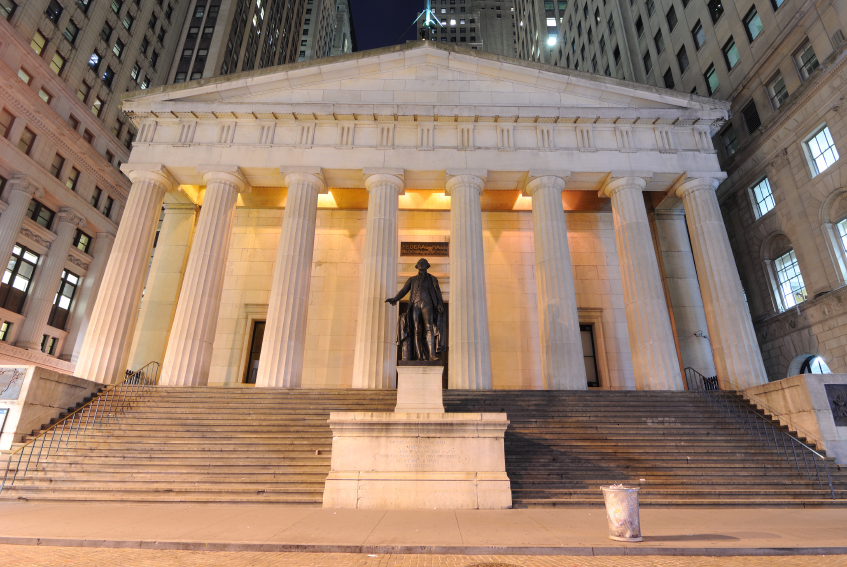
On the corner of Nassau and Wall Street in lower Manhattan, there is a building named Federal Hall, which was built in 1702 before the Revolutionary War.
Federal Hall may be New York City’s most important monument. It has served many important functions, including, NYC’s City Hall, the home of the Stamp Act Congress, the home of the Federal Government, a customs house, and a treasury.
It first served as a colonial City Hall for the British and played that part for many years.
In 1735, the John Peter Zenger Trials were held there, and John Peter Zenger was jailed, tried, and acquitted of libel for exposing government corruption in his paper. The trial was one of the first steps taken toward achieving freedom of press, and in a couple of decades, freedom of press would be written there in a formal document known as the Bill of Rights.
In 1765, the Stamp Act Congress convened here to write a letter to the king to ask for representation in Parliament (“no taxation without representation” created there). As you may know, the Stamp Act Congress was made up of delegates from 9 of the 13 colonies in America.
After the revolutionary war, in 1785, it was also a meeting place for the continental congress.
When NYC became the first capital of the US, a french born american named Pierre L’enfant enlarged and remodelled the Federal Hall.
In 1789, George Washington was inaugurated in Federal Hall when he became the first president of the US. Sitting at the top of the steps there, there is a bronze statue of George Washington commemorating that. This meant that the senate, house of representatives, and president would be located here.
In 1789, things like the Tariff of 1789 and the Judiciary Act were put into place there.
In 1790, congress ended its first session by passing twelve amendments; ten of which became the Bill of Rights. In 1790, when the second session of congress started, the naturalization act, the patent act, the copyright act, the indian intercourse act, and the compromise of 1790 were ratified in Federal Hall. The Judiciary Act gave the judicial power of the country to one supreme court, district courts, circuit courts, and district attorneys.Also in 1790 the second session of congress ended and the US capital was moved to Philadelphia, leaving Federal Hall to house the NYC government.
In 1812, Federal Hall was demolished. This happened because of the opening of the new NYC City Hall. Parts of the demolished city hall are on display inside the museum. The current structure that still stands was built as a customs house in 1842. In 1862, the customs house moved and it became one of six sub treasuries and was where the independent treasury system was developed. Millions of dollars of gold and silver were kept in the basement vaults. The new building is a classic Greco-Roman style, and was one of the first examples of the style of Federal buildings in America.
As of March 26, 1939, Federal Hall building was dubbed Federal Hall Memorial National Historic Site. In 1955, congress renamed it Federal Hall National Memorial in honor of the earlier edifice.

Federal Hall seemed to have serviced so many purposes. What service does it service in 2015?
ReplyDeleteIt's a museum.
DeleteWhat did Federal Hall serve as during the war in the years when the British had control of NYC?
ReplyDeleteEverything before 1776 (when the Americans declared independence), or where it says "After the revolutionary war," happened under British control.
DeleteWhen did federal hall switch form servicing the British to servicing the Americans? Also was there ever any controversy over who owned it/had use of it after the Americans gained their independence?
ReplyDeleteIt started serving the Americans somewhere within the time frame of the end of the reveolutionary war and when the Americans declared independence (I'm pretty sure). After the revolutionary war, it was property of the Americans (it served only as New York's City Hall). I don't believe there was ever any controversy over who owned it.
DeleteCould you maybe expand on the function of Federal Hall as a City Hall. How important was its role as City Hall during the revolutionary war?
ReplyDeleteFederal Hall was the site of many firsts and important events such as; the first American Congress, the Bill of Rights was adopted, the establishment of the federal government and President George Washington was inaugurated on the building’s steps in 1789. So suffice to say, City Hall was very important during the revolutionary war.
ReplyDelete